
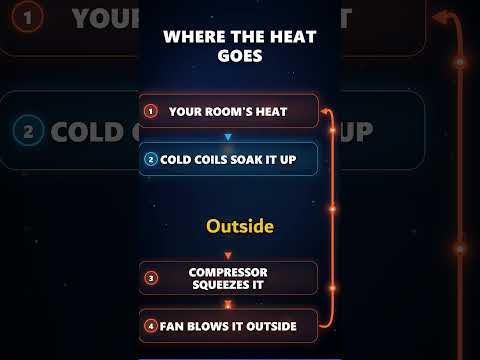
When you switch on an air conditioner on a hot summer afternoon, a refreshing stream of icy air blows into your room. It feels as if the unit is actively manufacturing cold air. But in the laws of physics, cold is not a physical substance that can be created; cold is simply the absence of thermal heat. An air conditioner does not create cold. It functions as a heat sponge, absorbing heat from inside your home and dumping it outdoors.
Boiling liquid inside copper coils
The cooling process relies on a closed loop of copper tubing filled with a specialized chemical called a refrigerant.
Inside your house, the refrigerant enters the indoor evaporator coil as a cold, low-pressure liquid. A blower fan pulls warm, humid room air across the outside of these chilly copper fins.
Because thermal energy naturally flows from warmer substances to cooler ones, the heat in your room transfers into the colder metal and into the refrigerant. The refrigerant has an exceptionally low boiling point, so absorbing room heat causes it to boil rapidly and transform into a cool gas. As room air loses its heat, its temperature drops, and the cooled air is blown back into your living space.
Squeezing heat out into the street
Now holding heat from the room, the gaseous refrigerant travels through insulated lines to the outdoor unit.
Here, an electric compressor tightly squeezes the refrigerant gas. Compressing the gas packs its molecules together, causing its pressure and temperature to rise sharply until it becomes hotter than the ambient outdoor air.
The scorching gas then flows into the condenser coil. A large outdoor fan pulls outdoor air across the coils. Because the refrigerant is even hotter than the summer street air, heat radiates out into the environment. As it loses heat, the refrigerant condenses back into a high-pressure liquid, passes through an expansion valve to drop its pressure, and returns indoors to repeat the cycle.
Invented for paper, not people
Modern air conditioning was not originally created for human comfort. In 1902, an American engineer named Willis Carrier built the first electrical air conditioning unit for the Sackett-Wilhelms Lithographing and Publishing Company in Brooklyn, New York.
During summer months, extreme humidity made paper stock swell and contract between print runs, causing colors to misalign and ruining expensive color printing jobs. Carrier's machine controlled indoor humidity by chilling the air and wringing out water vapor, stabilizing the paper. Human comfort cooling in theaters, stores, and homes came decades later.
The global energy footprint
Pumping heat outdoors takes tremendous amounts of electrical power. According to the International Energy Agency (IEA), air conditioners and electric fans consume nearly 20% of all electricity used in buildings worldwide. As global demand for cooling expands, developing more energy-efficient compressors and eco-friendly refrigerants has become a major engineering priority.
Sources
- Penn State College of Earth and Mineral Sciences (EGEE 102) - How Air Conditioners Work: Heat transfer and refrigeration loops
- Green Building Advisor - Compressor, condenser, and evaporator mechanics
- International Energy Agency (IEA) - The Future of Cooling: Electricity usage of air conditioners worldwide
- Wikipedia: Willis Carrier - Biography and invention of modern air conditioning in 1902
This article accompanies episode 2 of our series Tech Explained.